
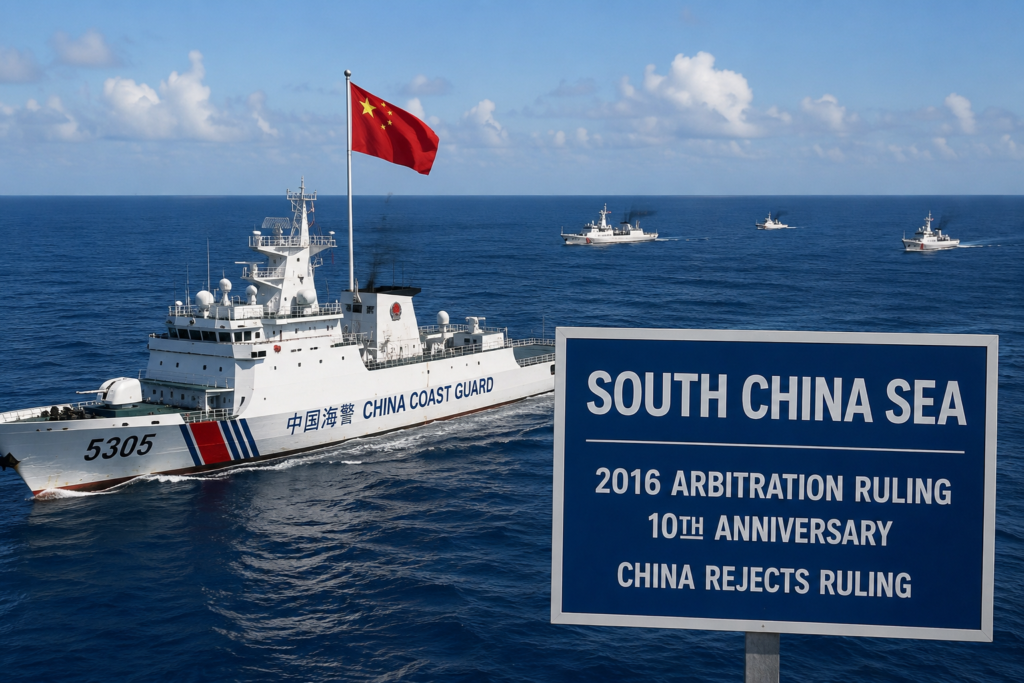
China has once again rejected the 2016 international arbitration ruling on the South China Sea, reaffirming its long-standing position on the ruling’s 10th anniversary. Chinese officials stated that the decision issued by the Permanent Court of Arbitration in The Hague has no legal validity from Beijing’s perspective and does not affect China’s sovereignty claims over the disputed waters.
The South China Sea remains one of the world’s most strategically important waterways, carrying trillions of dollars in global trade each year. Several countries, including the Philippines, Vietnam, Malaysia, Brunei, and Taiwan, have overlapping territorial claims in the region.
The arbitration case was brought by the Philippines, and in 2016 the tribunal ruled that China’s expansive “nine-dash line” claim had no legal basis under the United Nations Convention on the Law of the Sea (UNCLOS). China refused to participate in the proceedings and has consistently rejected the ruling, maintaining that the tribunal lacked jurisdiction.
On the anniversary, Chinese officials reiterated that the country’s sovereignty and maritime rights in the South China Sea are based on historical and legal grounds. Beijing also stressed its preference for resolving disputes through direct negotiations with the countries involved rather than through international arbitration.
Meanwhile, the Philippines and several Western nations continue to recognize the tribunal’s decision as legally binding and have called for respect for international law. The United States has also reaffirmed its commitment to freedom of navigation in the region, regularly conducting naval operations in the South China Sea.
Analysts say the dispute remains a key geopolitical flashpoint in the Indo-Pacific, influencing regional security, trade, and diplomatic relations. While tensions periodically rise, experts continue to encourage peaceful dialogue and adherence to international law to prevent further escalation and maintain stability in one of the world’s busiest maritime corridors.