
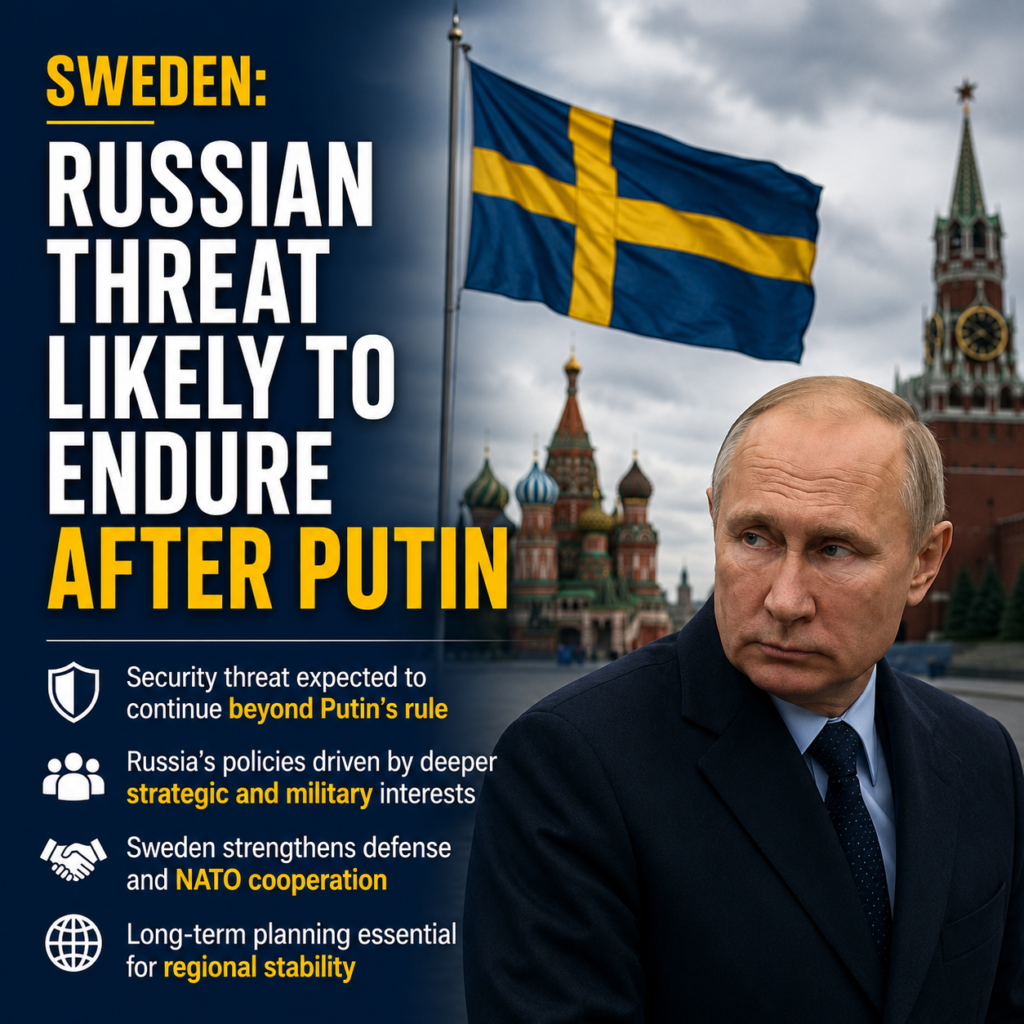
Swedish officials have warned that the security threat posed by Russia is likely to continue even after President Vladimir Putin eventually leaves power. The assessment reflects growing concern across Europe that Moscow’s long-term military ambitions and strategic objectives may extend beyond the leadership of any single individual.
According to Swedish officials, Russia’s policies are shaped not only by political leadership but also by broader military, security, and geopolitical interests. As a result, European countries should prepare for a prolonged period of heightened security challenges regardless of future political changes in the Kremlin.
Sweden, which recently joined NATO, has significantly strengthened its defence capabilities in response to Russia’s invasion of Ukraine. The country has increased military spending, expanded cooperation with NATO allies, and reinforced security measures in the Baltic Sea region.
Security analysts believe European governments will continue investing in defence, intelligence, and military readiness as uncertainty over regional stability persists. Officials argue that maintaining strong deterrence and close cooperation among NATO members will be essential to reducing future security risks.
While diplomatic efforts to end the conflict in Ukraine continue, policymakers caution that rebuilding trust between Russia and Europe could take many years. Sweden says long-term planning is necessary to protect national security and regional stability, emphasizing that future defence policies should be based on Russia’s capabilities and actions rather than expectations of political leadership changes alone.