
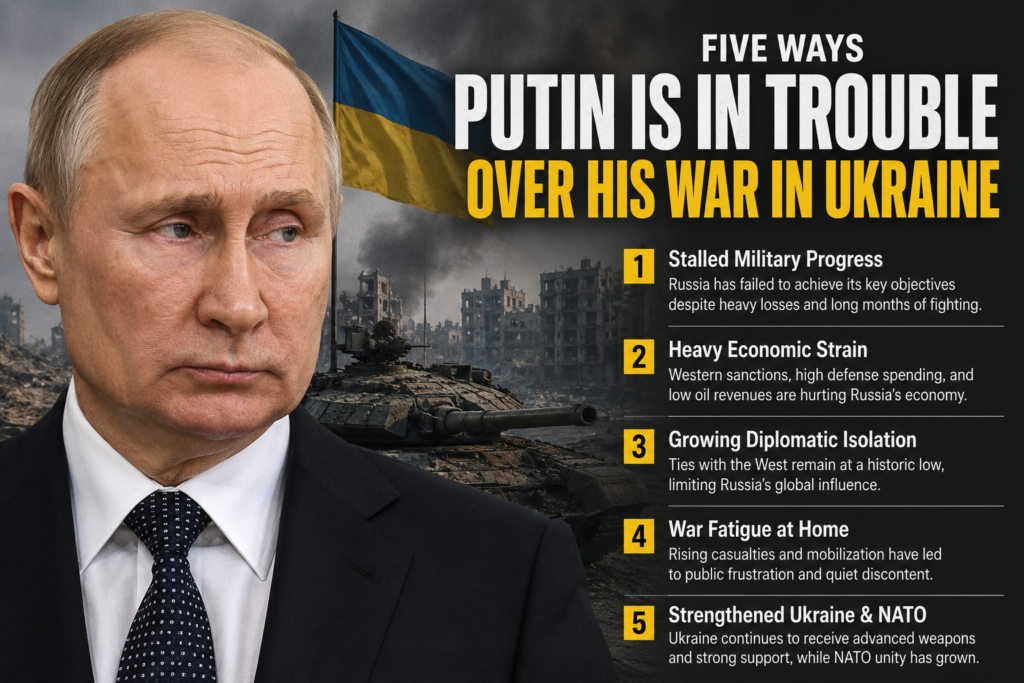
More than four years after Russia’s full-scale invasion of Ukraine, President Vladimir Putin continues to face mounting military, economic, and diplomatic challenges that are reshaping the conflict and Russia’s position on the global stage.
One of the biggest pressures comes from the battlefield, where Ukraine has continued to resist Russian advances despite Moscow’s larger military resources. The prolonged conflict has increased casualties, equipment losses, and operational costs for both sides.Economic sanctions imposed by the United States, the European Union, and other allies remain another significant challenge.
Restrictions on banking, technology, and energy exports have complicated Russia’s access to international markets, although the country has adapted by expanding trade with partners such as China and India.
A third challenge is the growing financial burden of sustaining a long war. Increased defense spending has boosted military production but also placed pressure on government finances and the broader economy.Russia also faces diplomatic isolation from many Western nations. While Moscow has strengthened ties with several countries outside the West, relations with Europe and North America remain highly strained, affecting trade, investment, and international cooperation.
Finally, uncertainty over the conflict’s long-term outcome continues to weigh on Russia’s future. The war has reshaped European security, increased NATO’s focus on defense, and created ongoing geopolitical tensions.Despite these challenges, the Kremlin maintains that its military objectives remain unchanged and has continued to invest heavily in defense and domestic industry. As the conflict evolves, developments on the battlefield, international diplomacy, and economic conditions will play a critical role in determining the next phase of the war and Russia’s strategic position.