
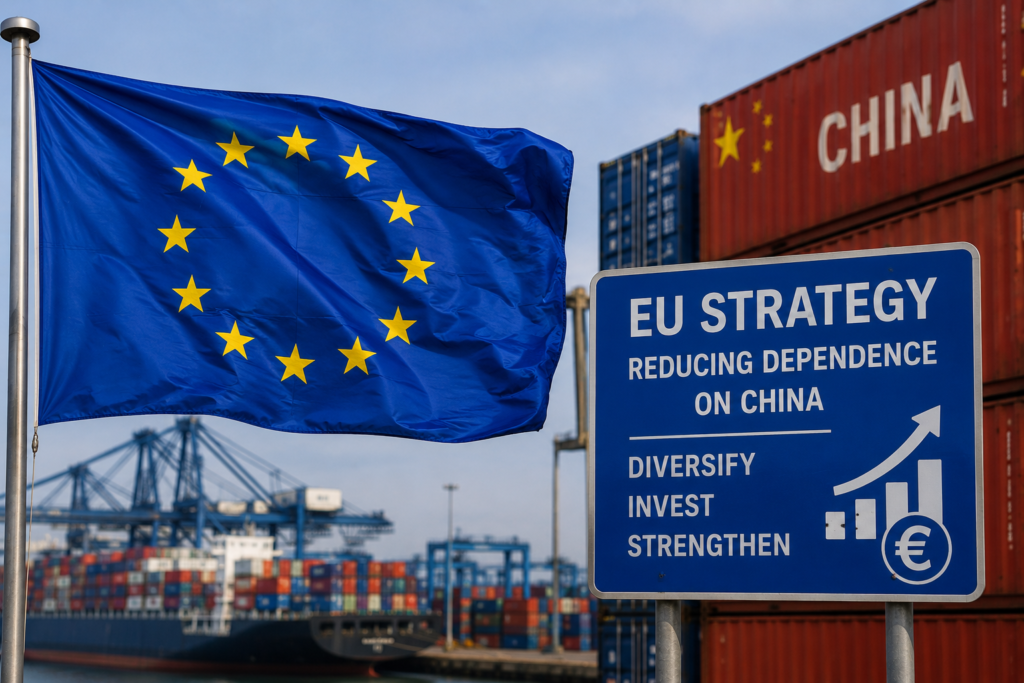
The European Union has warned that its long-term strategy to reduce dependence on China will require significant financial investment and close cooperation among member states.
European officials say diversifying supply chains is essential for improving economic resilience, but it will come with substantial costs for governments and businesses.The EU has been working to lessen its reliance on China for critical products, including semiconductors, batteries, rare earth minerals, pharmaceuticals, and clean energy technologies.
Recent geopolitical tensions and supply chain disruptions have highlighted the risks of depending heavily on a single country for essential goods.According to EU officials, achieving greater economic security will require billions of euros in new investments. Funding will be needed to expand domestic manufacturing, strengthen research and development, improve transport infrastructure, and support strategic industries across Europe. Policymakers also believe stronger partnerships with countries such as India, Canada, Australia, Japan, and Southeast Asian nations will help diversify imports and reduce supply risks.
Business leaders have generally supported efforts to build more resilient supply chains but caution that shifting production away from China will take time and increase operating costs. Many European companies continue to rely on Chinese manufacturing due to its large industrial base, skilled workforce, and well-developed logistics network
The European Commission has stressed that its strategy is focused on “de-risking” rather than completely “decoupling” from China. Officials say China will remain an important trading partner, but Europe wants to reduce vulnerabilities in sectors considered critical to national and economic security.
Analysts believe the transition could create new investment opportunities in renewable energy, advanced manufacturing, digital technology, and critical minerals. However, they also warn that higher production costs could temporarily affect consumer prices and business competitiveness.
As global competition intensifies, the EU is seeking to balance economic growth with strategic independence. Policymakers argue that investing in diversified supply chains today will strengthen Europe’s resilience against future geopolitical shocks and ensure long-term stability for its economy.
The EU is expected to continue introducing policies that encourage private-sector investment, support innovation, and expand industrial capacity while maintaining open trade relationships with trusted international partners. The strategy reflects Europe’s broader effort to secure its economic future in an increasingly uncertain global environment.