
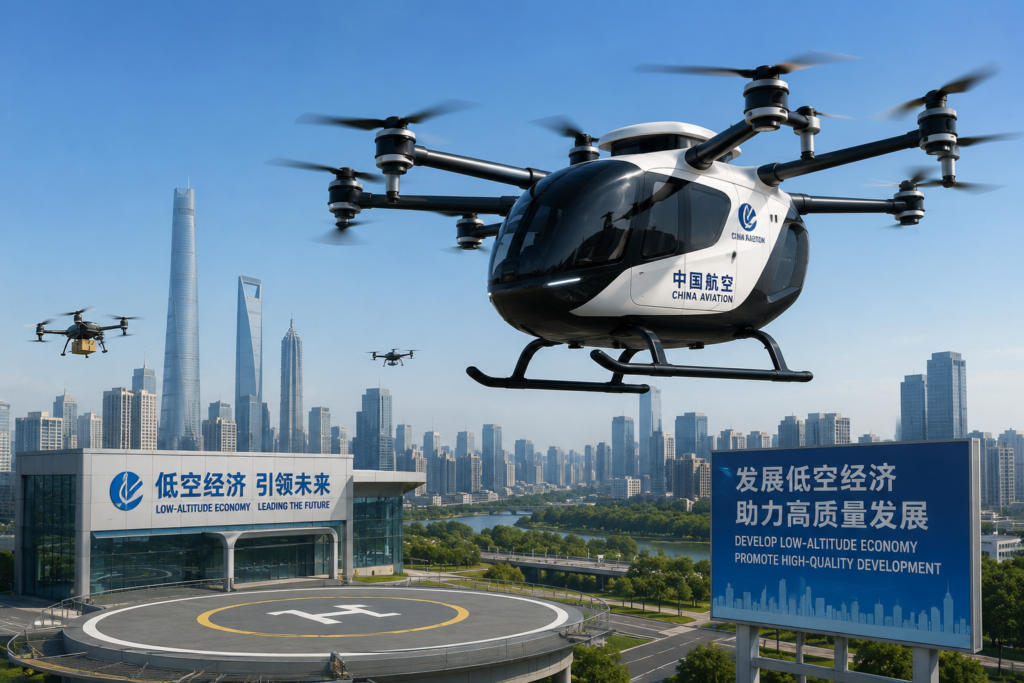
China’s aviation industry is preparing for a major transformation as one of the country’s leading aviation groups announced plans to focus on the rapidly emerging low-altitude economy.
The strategy reflects Beijing’s broader push to develop new industries centered on drones, electric aircraft, advanced air mobility, and urban aviation services.
The low-altitude economy generally includes commercial activities taking place below 1,000 meters, such as drone logistics, emergency rescue operations, agricultural aviation, aerial tourism, infrastructure inspections, and passenger air taxis.
Chinese policymakers view the sector as a key engine of economic growth and technological innovation over the coming decade.According to company officials, the aviation group plans to expand investments in research, aircraft manufacturing, flight services, and supporting infrastructure to capitalize on growing demand.
The initiative also aligns with China’s goal of building a more intelligent transportation network powered by advanced aviation technologies.Industry experts believe drone delivery services could become increasingly common in both urban and rural areas, helping improve logistics efficiency while reducing transportation costs.
Electric vertical take-off and landing (eVTOL) aircraft are also expected to play a larger role in future urban mobility, offering faster travel across congested cities.
Government support has been a major driver of the industry’s growth. Chinese authorities have introduced policies encouraging investment, simplified regulatory frameworks, and promoted pilot projects in several provinces to accelerate commercialization of low-altitude aviation services.
Analysts estimate that China’s low-altitude economy could become a multi-trillion-yuan industry over the next decade, creating thousands of high-skilled jobs in engineering, manufacturing, software development, aviation services, and infrastructure management. Companies involved in artificial intelligence, battery technology, autonomous flight systems, and telecommunications are also expected to benefit.Despite the promising outlook, challenges remain.
Safety regulations, air traffic management, battery performance, and public acceptance must continue to improve before widespread commercial adoption becomes possible.
Nevertheless, industry leaders remain optimistic that technological advancements and supportive government policies will position China among the global leaders in next-generation aviation.
As investments continue to grow, the low-altitude economy is expected to become an increasingly important pillar of China’s innovation-driven development strategy, reshaping transportation, logistics, emergency services, and urban mobility in the years ahead.