
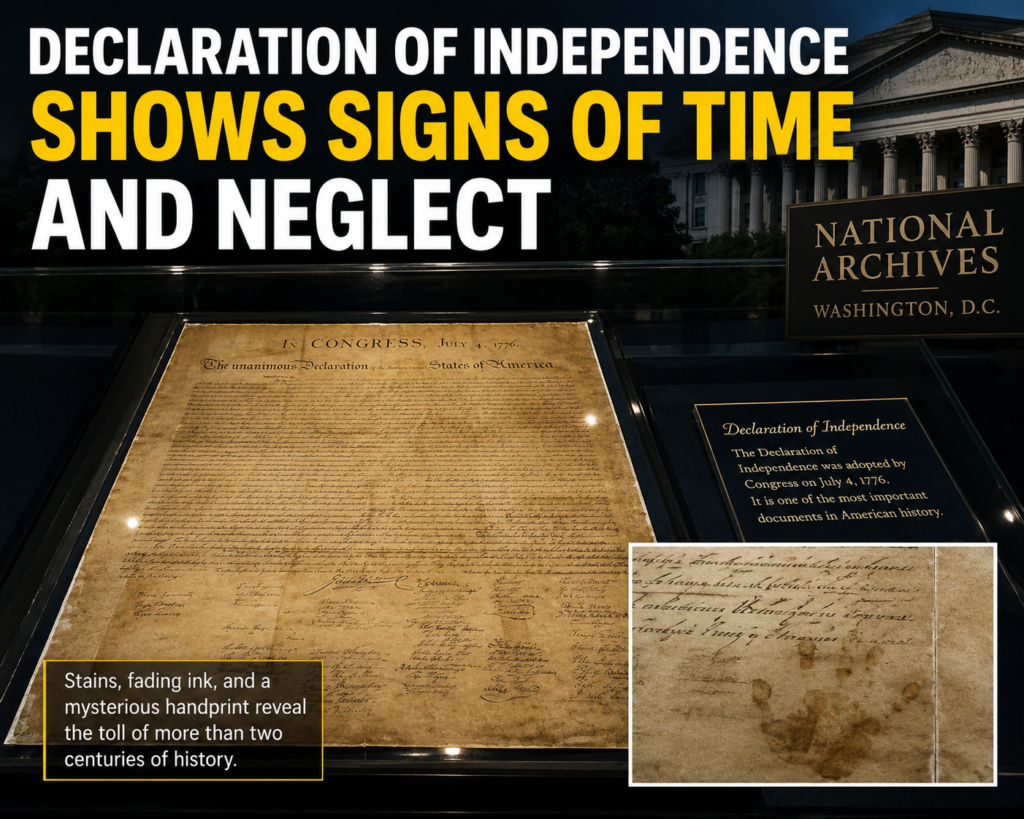
The United States’ Declaration of Independence, one of the world’s most significant historical documents, continues to attract millions of visitors each year at the National Archives in Washington, D.C. However, experts say the centuries-old document now bears visible signs of aging, including stains, fading ink, and even a mysterious handprint that has puzzled historians for decades.
Preserved under carefully controlled conditions, the Declaration has endured a long and difficult journey since it was adopted in 1776. Before finding a permanent home in the National Archives, it was transported across the country during wars, political upheavals, and changing governments. Exposure to light, humidity, repeated handling, and earlier preservation methods contributed to its gradual deterioration.
Conservation specialists have spent decades studying the document and developing advanced techniques to slow further damage. Today, it is displayed in a specially designed, climate-controlled case that protects it from harmful light, temperature changes, and moisture.
Historians believe the document’s physical condition tells an important story about the nation’s past and the challenges of preserving priceless historical treasures. While its appearance has changed over time, the Declaration’s message of freedom and independence remains as powerful as ever.
Officials continue to monitor the document using modern technology, ensuring that future generations can view one of America’s most iconic symbols of democracy and understand the remarkable history behind its preservation.